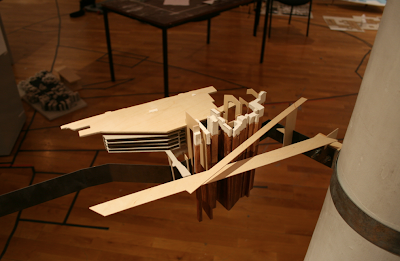
Counterpoint: noun The melody added as accompaniment to a given melody… in which melodies are thus combined.

Fothblog: Counterpoint

Showing posts with label Representation. Show all posts

Wednesday, 24 February 2010

Week 5: Affect, Atmosphere, Sensibility

Key Readings:

Wigley - The Architecture of Atmosphere

The texts by Pallasmaa and Wigley set out two counter arguments around the topic of atmosphere in architecture. For Pallasmaa, the atmosphere of a building comes about largely from an engagement with all the senses, beyond the purely visual. His argument is incredibly romanticised and in some respects an oversimplification (especially when he talks about 'natural' materials) though several parts of the essay do strike a chord with my own thinking. By contrast, Wigley argues that architecture can create atmosphere through a 'stage set' which does not depend on tectonic logic and is highly visual. He makes a convincing argument about the difficulty of approaching the topic of atmospheres in architecture - those who deny atmosphere still create them, and those who center their work around atmosphere displace themselves and their buildings. Whilst I agree that no matter how much the architect denys it, atmosphere is always created, I am less sure about the issue surrounding the second point. Does it really matter if the architect is displaced? If architecture is about the creation of atmosphere, does it matter that the building itself is subordinated?
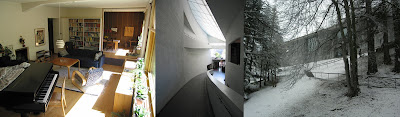

Haptic architecture - Travels in Helsinki & Vals: Aalto, Holl, Zumthor

Merleau-Ponty is referred to heavily in Pallasmaa's essay, especially with regard to the critique of ocularcentrism. The idea that the body is in a thickened relationship with the world, and that sight and touch are superposable, but separate conditions might help explain the relationship between the haptic and the visual in Corbusier's architecture, which seemingly prioritises sight.

A common theme that I notice grows throughout this course is the constant criticism of architectural representation. Perhaps this is rooted in the curious role of the architect between autographic and allographic artist. Since we do not (usually) realise our projects ourselves, a crucial part of all architectural discourse is how we communicate our ideas to others. Wigley's analysis of Frank Lloyd Wright and Le Corbusier's drawings reminded me of last week's text by Stan Allen, where he suggests that dry notational representation could ultimately be the best way to draw complex atmospheres. Another approach to emotive drawing could be seen in the 'digital' drawings of Gross Max, which do not attempt to simulate reality, but give a sense of the atmospheric intention behind the design (and in some of the imagery used, they are quite kitsch...).

Ideas about atmosphere were a part of my dissertation from 4th year, comparing and contrasting the 'tonal' atmospheres of Zumthor with those produced by Libeskind through a kind of structural tonality. In it I argued that Zumthor's notion of atmosphere had strong parallels with Peter Høeg's literary understanding of atmospheres and tonality:

"She Almighty had tuned each person in a musical key, and Kaspar could hear it... They reached the centre of the courtyard, and Kaspar got his first sense of their musical key. It was D-minor, at its worst. As in Toccata and Fugue in D-minor. Great fateful pillars of music." P. Høeg, The Quiet Girl, p. 3

The basic concept being that you could use musical tonality as a metaphor for describing the qualities of a space, which has interesting implications when looking at the transitions (or modulations) between spaces. Libeskind approaches atmospheres from a very different angle, based on a spatialisation of the musical scale, but in some ways reaches very similar effects. An interesting point is that both architects create an atmosphere around their work in how they write about and discuss their buildings. Libeskind in particular conjures up an aura around his use of music in design - he often refers to directly using music, but never explicitly as to how.
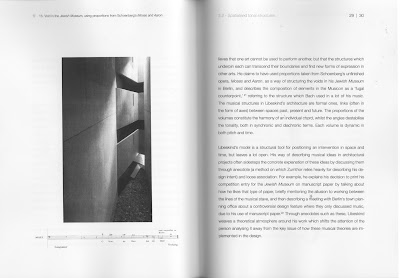

Atmospheres of structural tonality - Architectural Design Dissertation

In my opinion, Zumthor gets extra points for referring to music written for viola in his architectural writing. In Atmosphären, setting out his ideas about architectural atmospheres, he describes the opening to Brahms' Viola Sonata in E flat. He believes that whilst not as immediately powerful as those in music, the atmospheres created by architects can also have a very rapid effect on people. His chalk and charcoal design drawings convey a sense of the atmosphere from the outset, and by working through projects in large scale models he is able to come very close to the final atmosphere during the design process. This becomes a precise way of working with atmosphere, which he describes as "a little like tempering a piano, in other words, finding the right voice." Atmosphären, p. 35

Wednesday, 17 February 2010

Week 4: Programme, Event, Gesture

Key Readings:


This week, another set of texts which are very pertinent to the current design studio. Currently we are continuing our study of Cours Julien in Marseille, and some point soon will start to design pieces to test our ideas and the tectonic language that we are developing. As yet we have no idea as to what programme these will have, and may indeed be without programme. However, the ideas of Tschumi seem to us a good starting point for thinking about programme and event in our design. His belief that architects always have their own agenda is very relevant here, and when the time comes for us to think about the programme for our projects, we will not be able to have a passive attitude towards programme. Koolhaas' idea of the city as a programme is also of interest - does Marseille have a programme? It could be said with some certainty that areas of Marseille have a very distinct agenda - we recently found a French term for the inhabitants of our study area, Bobos - bourgeois bohemian - which describes the community's agenda quite well.

In the Manhattan Transcripts, ice skaters, tightrope walkers and military battalions overlap, creating a richly layered programmatic or event space. We believe that the nature of Cours Julien is heterotopic (using Lefebvre's definition of the term). This can already be seen in an investigation into the site's music scene, but its events and programmes also give weight to this argument. Some of those which we aim to record in our constructed site drawings:

- The first balloon ride across the Mediterranean, which took flight from La Pleine in 1899
- The collapse of a pioneering concrete bridge at Rue d'Aubagne in 1867
- The diurnal, weekly, and annual rhythms of Cours Julien
- Santa's sleigh meets a jazz trio, with cats sleeping on cars underground

Stan Allen's ideas on drawing and notation are very interesting in relation to our work as designers. The drawings below (and at the top of this blog) make attempts at temporal and anticipatory drawings of projects. I think that we can learn quite a lot from landscape architects, who have to consider the life and growth cycles of plants in their design work - it is an aim that I have had for a while now, to develop this multi-perspectival temporal drawing, moving through a landscape scheme across the seasons.

However, these drawings fail on several levels to be the kind of notation that Allen calls for - they are still very much analogue drawings, not the digital drawings where difference between reality and the image makes them more powerful. Similarly, they do not represent the invisible conditions of the projects - of particular interest to me of course is the sonic environment of a project. We will probably be working with a combination of analogue drawings and digital diagrams with our design projects, in order to convey different aspects of the scheme.

Allen's description of allographic and autographic arts is something that I had come across in my 2nd year music course, as well as in my research into Liszt last semester. The definitions are broadly speaking, very strong, however in relation to music, it is not as clear cut as Allen makes out. Can free improvised jazz really be considered to be allographic? This is further complicated with recording and editing technologies. Liszt was also one of the first musicians in the school of thought (against Schumann), who thought that the performance of music was much more important than the musical score, giving rise to the virtuoso performer.

De Certeau's chapter provides a good counterpoint to the grammatical view of architecture offered by Eisenman in last week's lecture and reviews. His and Tschumi's ideas of human activities creating space and performitivity interest Tom and I in our design work (mainly coming from Tom's house for Django Reinhardt - mine for Liszt was more about the construction of the piano than Liszt's performances). The text
provides an interesting (but complex) theoretical background to Tschumi's work. We are working at the moment mainly on the grammar and vocabulary of our architectural proposals, but soon we will need to consider the rhetoric, and for that, de Certeau and Tschumi will be good starting points. However, the big question is how to move on from the stage which both have brought us to today?

To end with a distortion of Tschumi's words:
To really appreciate architecture, you may even need to play music. Music in the Street differs from Music in the Cathedral in the same way as love in the Street differs from the Street of Love. Radically

Wednesday, 10 February 2010

E-Day reviews, and couple of other things...


Ok, so I still haven't mentioned last weeks' readings on semiotics, but it has been pretty busy preparing for interim reviews of our design work, with Peter Eisenman as visiting tutor.

Eisenman got very interested in one group's title of Marseille Archipelago, referring primarily to Ungers' Berlin as green archipelago. Thanks to my friends at Raumbureau, I know a little about it, through their exploration of the idea in Pilzen. However, Tom and I do not understand Marseille in the same way - in what we have seen, we think that there is far too much overlap of different communities and architectures to be able to draw out separate islands. So when faced with the question, 'what urban idea do we follow?', I am at the moment inclined to return to Lefebvre's heterotopias, or differential space. Looking at Cours Julien (model below), we see an area where many different cultures overlap, something that we were even able to identify from a distance by looking at the distribution of different types of musical performance across the city.


A theme that came out in reviews, and more so in Eisenman's lecture was one of architectural grammar. The key question he asked us was around what it means to design in Marseille; what about our projects reflect the grammar of Marseille? In his lecture, he argued that currently we have a new rhetoric, but not an architectural grammar to deal with it. This reminded me a lot of Eco's essay, in particular his description of the anthropological approach, in which the architect must first understand the codes around which a society works, in order to develop an architectural response that is aware of its meaning in the society. Part of what Tom and I have been looking at in Cours Julien tries to gain an understanding of what certain things mean in that context; in particular, void and casing.

Whilst drawing to get ready for the reviews I've been listening to Kafka's The Trial. One line in particular reminded me of the previous week's readings on the surveillance society. Whilst talking to the painter, K is interrupted by a group of young girls, trying to listen in on their conversation. The painter then explains to K that 'these girls too belong to the court.' In other words, everyone around him is involved in the mechanisms of discipline and control within the city. Kafka's writing often seems to predict a world of bureaucracy and power which is becoming more prevalent today.

Again, preceding the update on semiotics, I came across this project in China, based around the piano. If I ever produce anything like this, then please stop me!! To use Jenck's terms, it is not an enigmatic signifier, but a definite one-liner. Its lack of appeal perhaps comes from its instant comprehension and dismissal as something very trivial, the idea too obviously translated into built form. Its overcoding makes it liable to become redundant very easily.

Strangely, Eisenman heard that someone in the class was interested in Liszt, and without hearing any more detail, described the terrible city that he imagined this student to be designing based on music translated directly into architecture via some strange computer algorithm... I was very tempted to point out that this particular student had no inclination to do that whatsoever. Or perhaps even more tempted to play along with the idea to see what would happen...


Wednesday, 3 February 2010

Week 1: Fields, Diagrams, Mapping

Key readings:
James Corner - The agency of mapping
Deleuze and Guattari - Introduction: Rhizome
Ben van Berkel, Caroline Bos - Diagrams - Interactive instruments in operation

The ideas of each of the authors help focus the design studio work, where we are trying to map aspects of Marseille. The Deleuze and Guattari introduction on rhizomatic thinking in particular has been inspirational, whilst the Corner reminded us that mapping is actually an incredibly creative act. In addition, the examples of contemporary mapping strategies, whilst familiar, were explained in a clear way, which made them useful precedents. I found the van Berkel and Bos essay frustrating in its reductive style, making leaps between ideas which were not well explained (perhaps I need to look into the examples of Foucault, Bacon, and Proust more myself in order to get more out of it). The fairly literal transfer of diagram to building also feels a little contrived.


The challenge has been taking these ideas into design. I suspect that however much we try, our maps still stay to some extent tracings of what we found on the ground.


Back in week 1 (this is a retrospective upload...), I was working with Thom on mapping the aural architecture of Marseille (above). This could be a narrow field of interest, but attempting to think rhizomatically opens the potential to connect threads of ideas about sound to other fields of interest, social, political and infrastructural amongst others. Now a couple of weeks later, with hindsight we are looking at the one of the same geographic areas from that time, but looking at the 'casing' and 'voids' within the city (below, in progress). For me, the casing is a direct follow-on from the piano metaphor I used last semester, the term is useful on several levels, including on a sonic level. As a method of mapping, this already seems more productive. It is a much more critical creation of a field, onto which extracts, as existing and new interventions are being plotted (Corner's terms). As a result of this careful selection of voids and casing, we are coming to understand the meaning these terms have in Marseille (a point that is very relevant to week 3's readings on semiotics).


If, as Corner suggests, by the creation of this map we transfer agency from ourselves to it, then it will help direct our own design projects. This would combine an understanding of the field in which we are working (Marseille) and our own interests (the piano, fill in other blanks as I work out what they are...). At the moment, I don't envisage our study site being one for my final thesis project, but being able taking 'lines of flight' to other areas of the city might be a clue as to how to develop the project further.

"Music has always sent out lines of flight... musical form... is comparable to a weed, a rhizome." Deleuze & Guattari, p. 11-12
Later, in the 11th chapter of A Thousand Plateaus, Deleuze & Guattari refer directly to the music of Pierre Boulez as an example of the rhizome in music. Another example would be the pure milieu of Ligeti's Clocks and Clouds, where the music oscillates between points and flows of sound, thus setting up a field condition in which no discernible cadences can be found, no beginning, or end.