Counterpoint: noun The melody added as accompaniment to a given melody… in which melodies are thus combined.

Fothblog: Counterpoint

Showing posts with label Networks. Show all posts

Tuesday, 30 March 2010

Confused transnational networks...


Sitting on the train from Edinburgh to London, using East Coast Mainline's free wireless. Apparently we have left the UK. Spotify has started playing Swedish adverts at me (very funny they are too, despite or because I don't understand them!). Another reminder that virtual and physical networks and spaces do not map 1:1 onto one another...

Plus; from the train, the junkspace that grows up around railway lines - a collection of shopping centres - seems no where near as fantastic and full of possibilities as Koolhaas asserts...

Thursday, 4 March 2010

Week 6: Technology, Infrastructure, Hardware

Key readings:


Latour's essay on 'the sociology of a door-closer' seems to affirm the position of the course here at Edinburgh, where architecture is seen as a social product (although as Zaera Polo reminds us, also political, economic, technical...). His argument wittily shows how studying social relations purely between humans is a false idea, since it grossly oversimplifies the complex relations between humans and non-humans. For us, we can look at it from the other perspective - to study the relations between spaces and (non-humans) without looking at the social relations that occur around and within them would be false, since it ignores the fact that social relations are written into the architecture that we create.

Zaera Polo's opening gambit got me interested, but I found his way of writing convoluted and perhaps as a result, many of the ideas seemed unconvincing. He claims to be investigating the politics in architecture, but then constructs an argument entirely around the envelope, which he claims gives us the most potential. However, the reduction to 4 different types of envelope and the different political battlegrounds they come with seemed a little too simplistic (although perhaps it was necessarily so). Especially in light of Tschumi's approach, Zaera Polo seemed to take a very uncritical approach to programme, simply equating function with a formal typology. As a result I felt that he really missed an opportunity to engage with something that could be strongly political - if we don't question the programme, can we really design critically for it?

At this stage of the design process, Splintering Urbanism is the easiest text to relate to. We have been looking at the development of our site over time (below right), trying to discover what its 'agenda' is. Part of this has involved looking the transport links of the site (See below left. As yet, we do not come close to Graham & Marvin's aspiration that architects involve all kinds of infrastructure in their analysis). Our site has gained significance through strong transport links (Part of the first 'ring road,' early tram connections, metro, and underground car parking). It might be an interesting study to see which areas have been detrimentally affected by the changes which strengthened our site.


As we start to design fragments of our projects, the ideas of Latour (and perhaps Zaera Polo) become more relevant. We are looking at the interface between a 19th Century axis and the Cours Julien area of Marseille, trying to understand how we can design for this condition of a strongly independent area in contrast to a large scale urban strategy. Understanding the social and political relations embedded in the space will be key to the success of any design moves.

The combination of Latour's deconstruction of human and non human relations with the ideas of networks and urbanism reminded me of this news story from September. Clearly in this case, the delegation of a task from human messenger to non-human carrier pigeon (via computer, memory stick etc.) is more effective than to an unreliable network...

In the tutorial we had an interesting discussion following on from Grimshaw's lecture on Monday. His architecture references machines throughout, exposing the structure of the building, and in the FT printworks showing the mechanism of printing the papers. However, in an age where technology is compact and hidden behind an ipod case, the machine reference is no longer relevant. To what references can we design, or does this new technological era lead even more towards bubble architecture?

Wednesday, 3 March 2010

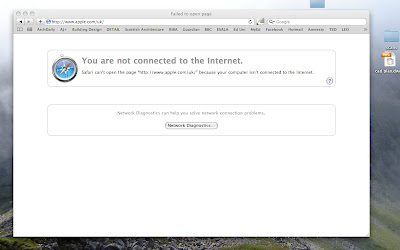
Week 6: Failed to open page

I was going to update this morning, only to get this screen:


The uni's internet wasn't working. Oh the irony... Unable to get to google maps, photos of the site, or references to other projects, our reliance on the internet was exposed:

"The normally invisible quality of working infrastructure becomes visible when it breaks: the server is down..."
- Graham & Marvin, Splintering Urbanism, p. 32

The idea of connection to a network of infrastructure exercises fascination in many popular musicians:
Regina Spektor, Machine

Thursday, 4 February 2010

Week 2: Capsules, Networks, Surveillance

Key Readings:
Foucault - The Eye of Power

This week, a much darker set of texts about the contemporary city. Castells' essay lays out key issues surrounding urbanisation and globalisation, pointing out the possibilities and dangers of a society that is increasingly fragmented. Whilst it has strong points, it did feel like a highly repetitive essay with each point being repeated over and over again. Also to bear in mind when reading, it was written in 2004, and much has changed since then - social networking and twitter, to name only a couple. The two essays by de Cauter, both angry in style, describe the rise of a capsular society. However, the second text, on heterotopias read a bit too much like a review of a few books that the author had read (thats what this is... sort of). The interview with Foucault is an illuminating text on panopticism and the surveillance society, which he argues is diagrammed architecturally in Bentham's Panopticon prison.

A frustrating point in Castells' essay is when he starts to discuss the role of architects in society - apparently, our most important task is that of creating 'meaningful forms.' (Castells, p. 452) Is this too reductive a statement? Perhaps I take it too literally as form-finding, which I would find too narrow an idea to by our primary task.

What can we as architects do within these conditions? We don't (and perhaps shouldn't) have the power to change society, politics, or economics. But we need to be able to work with and around these trends. It may be that buildings we design make small changes, which are part of the seeds of greater changes. Importantly, we need to be aware of the politics of space, since if we are unaware, then we can be easily manipulated against our own ideals.

The surveillance society is a very modish theme in the press at the moment. As one of the most watched societies in the world, there are cameras wherever you go. But is anyone actually watching? The idea of a self-disciplining society reminded me of a news story from October last year, about a website where members of the public are able to earn money by spotting crimes on live CCTV feeds. And then people start getting upset, when members of the public take photos... On a similar note, two fantastic recent(ish) films about surveillance societies, both questioning who the beneficiary of surveillance really is: Red Road, and Das Leben der Anderen


Back to the design studio, de Cauter's attack on cultural capitals is very relevant, with Marseille holding the European title in 2013. This spectacle of culture is already being greeted with suspicion - the musicians we spoke to there saw very little positive coming out of it. Presumably someone, somewhere is making a lot of money out of it, and its resulting in projects which probably won't benefit the city in the long term (at least, not as much as better housing, infrastructure...). The culture of fear that pervades a surveillance society is also evident in Marseille - many gated communities surround the centre, with the aim of reducing crime and reducing their insurance premiums. Paradoxically, the gates signify wealth, and in some cases the crime rate has risen since they shut themselves away. As France's second largest city, with a very diverse population, the interaction between flows and places is highly complex. I don't know what I will end up designing, but these issues will almost certainly become relevant. Still looking at the aural architecture of Marseille, where musicians find it too loud to record music, the government policy focuses almost entirely on quantitative measures of sound reduction. The politics of silence (balance of freedom of expression, against a right to silence, or at least a right to good quality sound) is a theme that I'd be interested in exploring, one which would strongly affect our understanding of the city.

Quite a long post for this one - so many issues to contend with, and I've only picked out a couple... De Cauter's capsular dystopia is quite depressing (note to self: must design for integrating societies). The obvious music for the readings is Hard-Fi's Stars of CCTV - any better suggestions welcome!